


GROWTH
WHY BETTER MARKETING DOESN’T ALWAYS CREATE BETTER GROWTH
Marketing has never been more measurable, targeted or sophisticated.
Yet many organisations still struggle to achieve sustainable commercial growth.
Why do some companies redefine entire industries...
...while others spend millions trying to keep up?
Ryanair.
Amazon.
Revolut.
Netflix.
Uber.
They didn't simply create better advertising.
They redesigned how value was created.
Marketing accelerated that advantage.
It wasn't the advantage itself.
That observation changed how I think about commercial growth.
“Every company should behave like either a startup...
...or a turnaround.”
I heard those words over a decade ago.
At the time they sounded clever.
Today they feel increasingly true.
Startups build around today's customer expectations.
Turnarounds question yesterday's assumptions.
The danger lies in businesses that do neither.
I kept seeing the same pattern
Over twenty-five years I've worked in agencies, telecoms, startups and consultancy.
Agency.
Telecommunications.
Consumer apps.
Consulting.
Four countries.
Hundreds of meetings.
Same pattern.
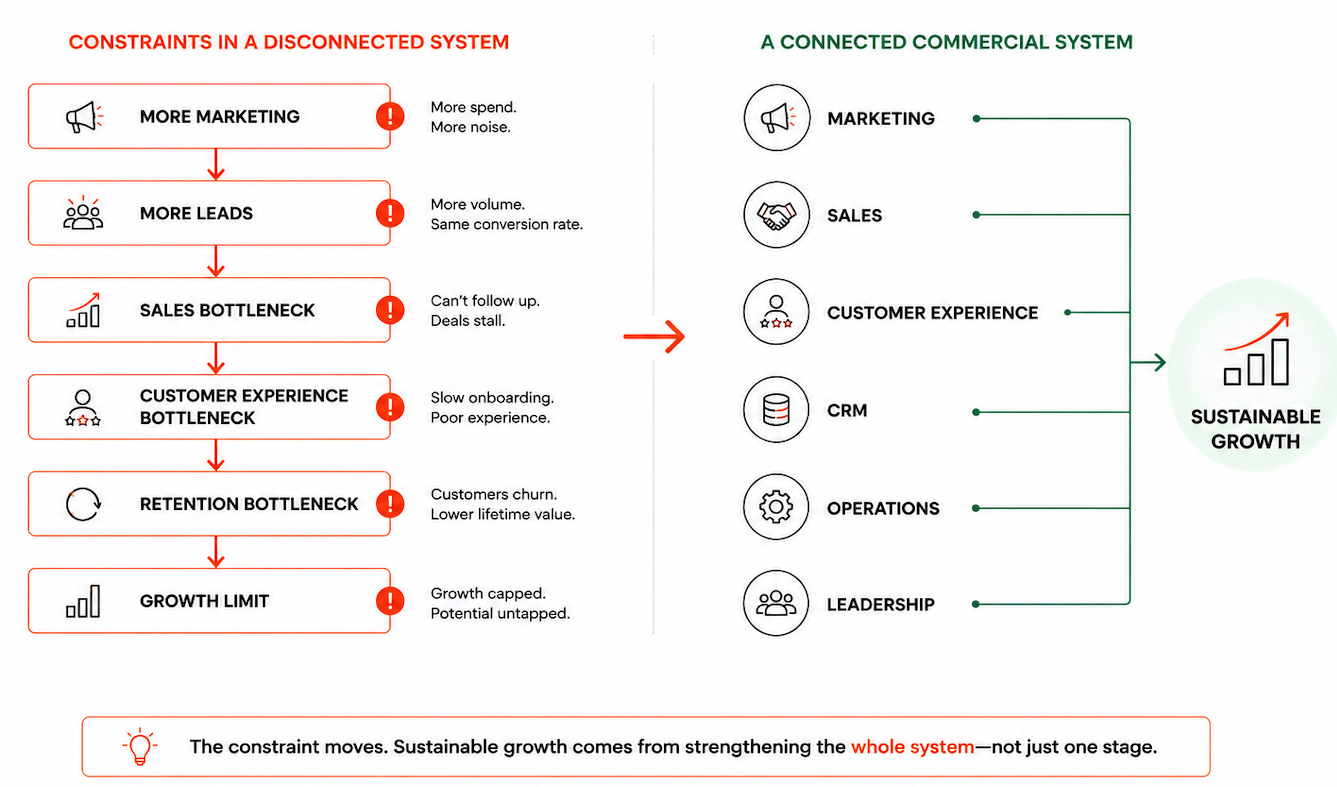
Eventually I realised I wasn't looking at a marketing problem.
I was looking at a systems problem.
That's what eventually became
The Growth Constraint Model.
One organisation invested heavily in marketing.
Campaigns were everywhere.
Christmas.
Back to school.
Competitor launches.
New products.
The work was good.
The people were talented.
Yet every campaign felt like a fresh start.
Marketing was organised around events.
But their customers weren't.
It become obvious that most organisations were optimising campaigns, despite what was said...
...instead of customer journeys.
The Role That Changed My Perspective
Everything changed when I moved into Customer Value Management.
Until then success meant acquiring customers.
More campaigns.
More downloads.
More leads.
More acquisition.
Suddenly success meant something different.
Retention.
Behaviour.
Lifetime value.
Customer health.
For the first time, I could see the customer journey from beginning to end.
And that's when something became obvious.
Nobody Owned The Journey
Marketing owned campaigns.
Sales owned pipeline.
CRM owned messaging.
Customer Care owned complaints.
Digital owned the app.
Finance owned EBITDA.
Customers owned the experience.
Nobody owned the journey.
“Customers experience one business.
Internally many organisations behave like six.”
The Dashboard Illusion
I've built executive dashboards.
Power BI dashboards.
Marketing dashboards.
Commercial dashboards.
Most answered one question brilliantly.
"What happened?"
Very few answered the more useful one.
"Why?"
The technology is no longer the constraint.
Twenty years ago...
Different systems.
Different teams.
Different data.
Today...
CRM.
Marketing automation.
Customer data.
Analytics.
AI.
The constraint isn't technology anymore.
It's how organisations are designed.
Questions that leaders should ask
Where is commercial growth actually being constrained?
Who owns the customer journey from beginning to end?
If marketing doubled its performance tomorrow, would the rest of the organisation be ready?
Are your teams optimising their own KPIs... or the same commercial outcome?
These aren't marketing questions.
They're leadership questions.
I didn't create DMT because businesses need more marketing.
I created it because I kept seeing talented organisations working incredibly hard...
..without always working together.
Commercial growth is no longer just a marketing problem.
It's a systems problem.
And when one part of the system is constrained, better marketing doesn't remove that constraint.
It reveals it.
Continue the conversation
If this resonates with how you think about growth...
I'd love to hear your perspective.