


GROWTH
MOST ORGANISATIONS INVEST IN SPONSORSHIP. VERY FEW BUILD SPONSORSHIP GROWTH ENGINES.
Sponsorship can build awareness, trust and customer connection.
But buying the rights is only the beginning.
Sponsorship works
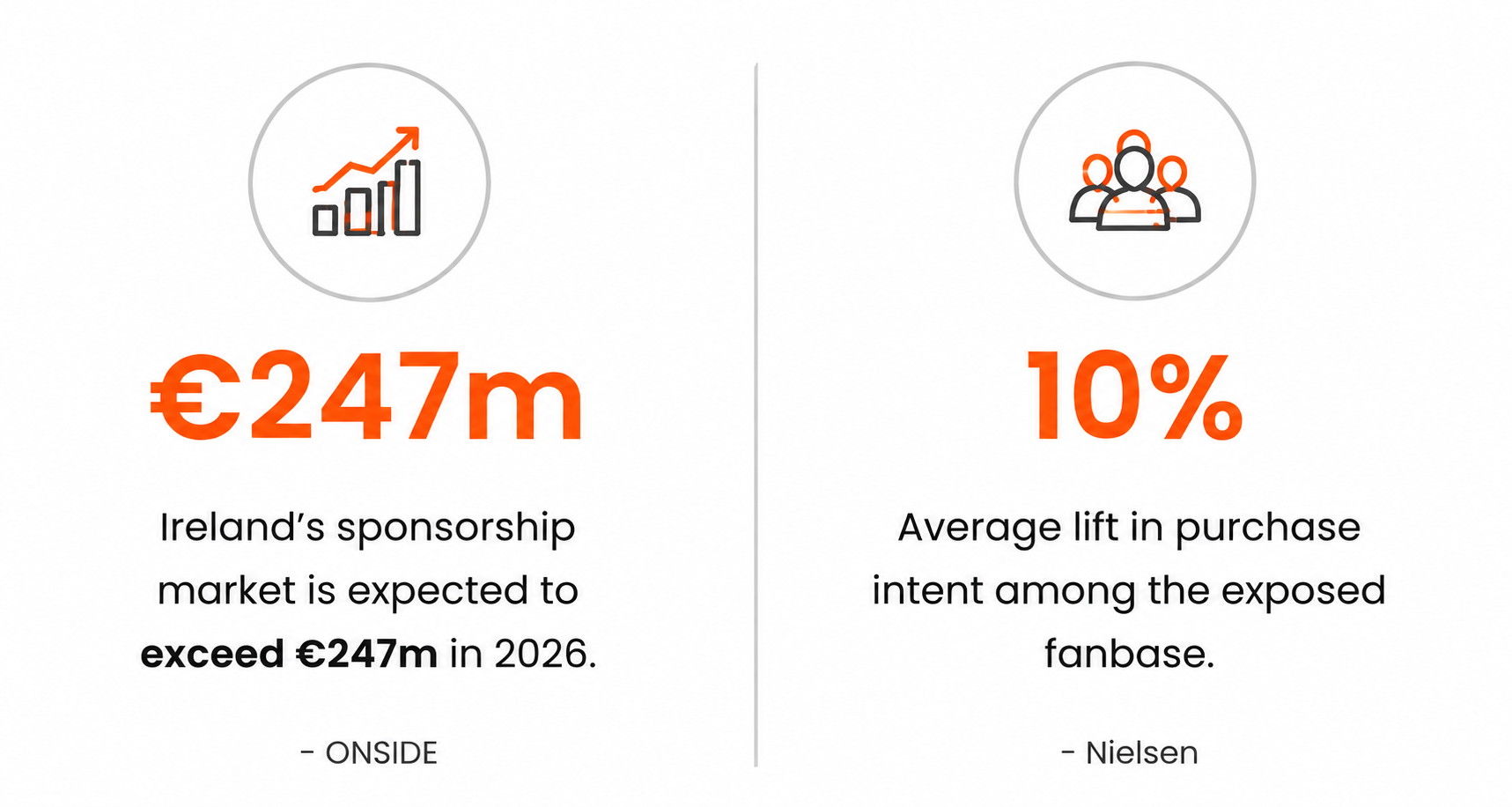
Ireland's sponsorship market is expected to exceed €247m in 2026.
Nielsen research across 100 sponsorships found an average 10% lift in purchase intent among the exposed fanbase.
So the question isn't whether sponsorship can create value.
It's whether organisations are extracting enough value from the sponsorships they already own.
Because buying sponsorship rights and activating them are two very different things.
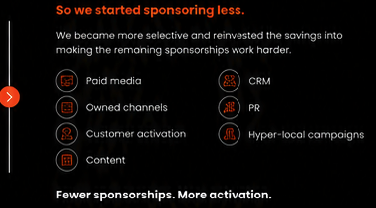
I learned this when sponsorship stopped being an advantage.
I worked with a telecommunications business that became one of the most active sponsors of sport, music and community initiatives across the Caribbean.
Initially, sponsorship was enormously powerful.
It helped us enter markets, build awareness and become part of local communities.
Then competitors stepped up.
Simply sponsoring more was no longer enough.
The sponsorship is only the beginning
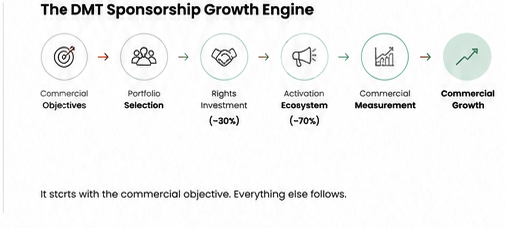
Over time, I developed a simple rule of thumb:
≈ 30%
RIGHTS
≈ 70%
ACTIVATION
The exact ratio will vary.
But the principle matters:
Don't spend so much securing a sponsorship that you can't afford to make it work.
Research into sponsorship activation supports the broader principle, with published activation ratios ranging from approximately 1:1 to 8:1 depending on the sponsorship and objectives.
30/70 is my practical rule of thumb, not an industry benchmark.
Different sponsorships create different opportunities.
SPORTS TEAM
Community & trust
Throughout the season
Content, customers, local activation
BUSINESS EVENT
Relationships & pipeline
Before, during & after
Meetings, CRM, follow-up
VENUE / STADIUM
Long-term awareness & salience
Always-on
Awareness, experiences, partnerships
COMMUNITY / CHARITY
Trust & reputation
Programme-led
Participation, stories, engagement
The property changes.
So should the growth engine around it.
A sports team isn't an event.
It's a story unfolding over a season.
Pre-season → Big games → Players → Supporters → Wins & losses → Local stories → Finals
As attention builds, activation should build with it.
Content → Paid Media → Customer Engagement → Hospitality → Local Activation → CRM
If a team reaches a major final, the communications plan shouldn't suddenly start that week.
It should have been designed to get there with them.
From visibility to commercial value.
Consider insurance.
Trust, reputation, recommendation and local presence all matter.
A sponsorship can help an organisation become part of the community it serves.
But the logo itself doesn't create that relationship.
The surrounding activity does.
And that changes what we should measure.
Rather than only:
Reach → Impressions → Media Value
Also consider:
Awareness → Engagement → Consideration → Enquiries → Referrals → Customer Value
Measurement should be designed before the sponsorship begins.
Not reconstructed afterwards when somebody asks whether it worked.
Before renewing your next sponsorship, ask three questions.
1 - Why do we own it?
2- Are we investing enough to activate it?
3- What commercial behaviour should it ultimately influence?
The sponsorship isn't the growth engine.
It's the fuel for one.
Sponsorship doesn't necessarily need more budget.
Sometimes it needs more focus around fewer properties.
And a much clearer connection between the sponsorship, the customer and commercial growth.
Continue the conversation
If this resonates with how you think about growth...
I'd love to hear your perspective.